


 English
 عربى
 русский
 Español
Pigment Yellow 42: Key Selection Criteria for Industrial Buyers Explained
Content
- 1 What Pigment Yellow 42 Actually Is
- 2 Seven Numbers That Belong in the Purchase Specification
- 3 Heat Stability: Why 180 °C Is the Practical Ceiling
- 4 Dispersion and Colour Difference: The Two Verifiable Outcomes
- 5 Compliance: Match the Certificate to the Destination Market
- 6 Supplier Qualification: Six Checks Before the Purchase Order
- 7 Price Per Tonne Against Price Per Unit of Colour
- 8 Questions Industrial Buyers Ask Before Ordering
What Pigment Yellow 42 Actually Is
Pigment Yellow 42 is the Colour Index designation for synthetic yellow iron oxide, a hydrated ferric oxide with the goethite crystal structure and the CAS number 51274-00-1. Cosmetics regulators list the same substance as CI 77492, and in the European Union the identical chemistry is authorised as the food colour E172.
Pigment Yellow 42 (C.I. 77492) is a synthetic goethite pigment, alpha-FeOOH, that delivers a lightfast, alkali-resistant yellow without the heavy-metal chemistry of chrome or cadmium yellows.
The iron oxide family is indexed by colour rather than by chemistry: CI 77491 for red, CI 77492 for yellow and CI 77499 for black. Because all three share the same oxide base, they blend without the compatibility failures that appear when organic and inorganic pigments meet in one batch. That is why most terracotta, tan and brown building products are built from two or three iron oxide grades rather than a single pre-matched colour.
Inside that family, PY 42 is the only true yellow and the only member that dehydrates. Natural yellow ochre carries the same mineral with higher clay and silica content, which is why industrial volumes are supplied almost entirely as synthetic pigment with a controlled particle size distribution.
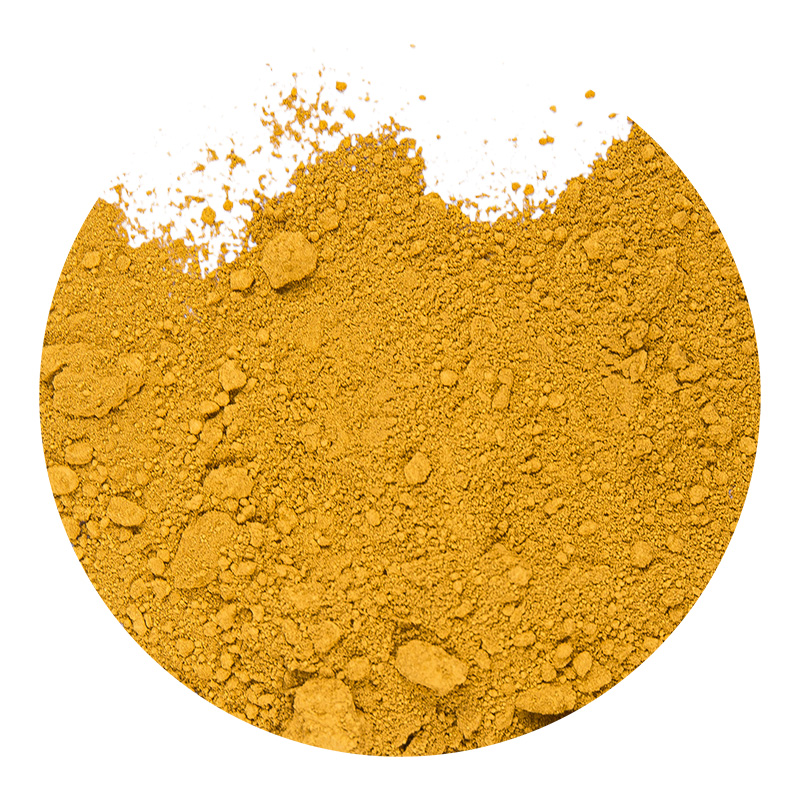 Iron Oxide Yellow Pigment PY 42 Grades 313, 920 and E172Synthetic Pigment Yellow 42 for concrete, coatings and ceramics, with grades 313, 920 and E172 and controlled particle size.View Product →
Seven Numbers That Belong in the Purchase Specification
A workable Pigment Yellow 42 specification fits on one page: iron content, tinting strength, moisture, sieve residue, water-soluble salts, pH and oil absorption. Everything beyond that list is a conversation about colour, and colour is the parameter that varies least between competently produced lots.
| Parameter | Typical purchase window | Test reference |
| Iron content as FeOOH | 86 percent minimum | ISO 1248 |
| Tinting strength | 95 to 105 percent of retained standard | ISO 787-24 |
| Moisture | 1.0 percent maximum at 105 °C | ISO 787-2 |
| Residue on 45 micron sieve | 0.10 percent maximum | ISO 787-7 |
| Water-soluble salts | 0.5 percent maximum | ISO 787-3 |
| pH of aqueous extract | 4 to 7 | ISO 787-9 |
| Oil absorption | 25 to 35 grams per 100 grams | ISO 787-5 |
Tinting strength is where the negotiation actually happens. Two suppliers can both quote Pigment Yellow 42 and still deliver powders that differ by 10 percent in colouring power, which moves your let-down ratio and your cost per coloured unit. Buyers running a fixed formulation should purchase against a retained standard and treat Chinese grade labels such as iron oxide yellow 313 as a strength band rather than a complete specification.
Heat Stability: Why 180 °C Is the Practical Ceiling
Pigment Yellow 42 holds its hue to roughly 160 to 180 °C. Above 200 °C the goethite lattice loses its water of crystallisation and converts toward red hematite, so a process that peaks higher should not be specified on PY 42 alone.
The conversion is gradual rather than a step change. A formulation processed at 190 °C can look acceptable in a single sample and then drift across a production week as furnace loading changes. Where shade has to hold across a long run, buyers either move the yellow component to a heat-stable grade or accept the red shift as part of the target colour.
Blending is the practical route. Yellow combined with red and black iron oxides produces the earth tones used in paving, render and roof tiles, and a pre-compounded brown removes the batch-to-batch blending risk that comes with doing it in-house.
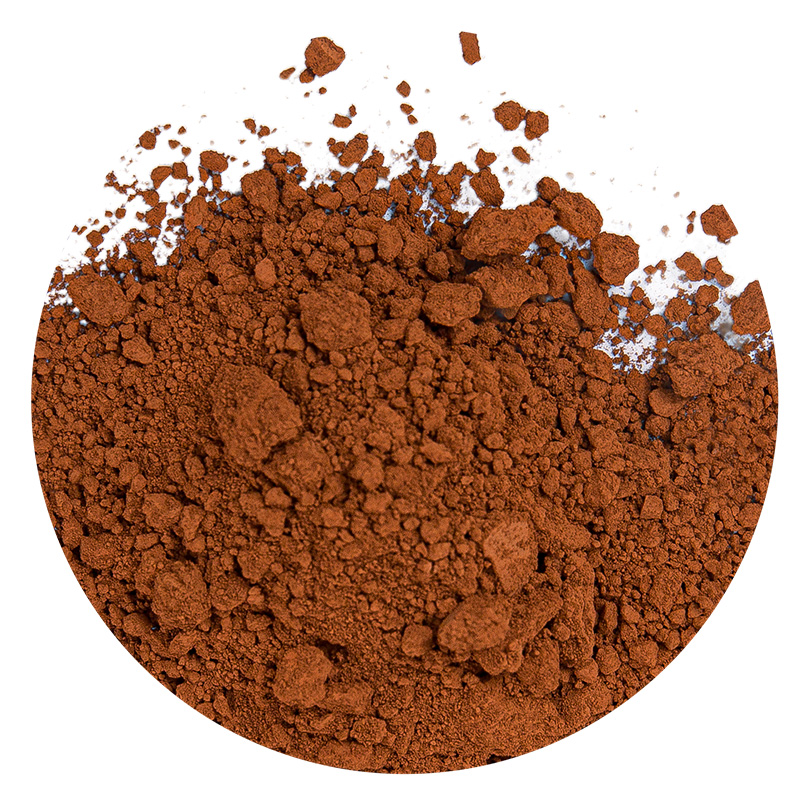 Iron Oxide Brown Pigment Grades 610, 640 and 686Pre-compounded iron oxide brown pigment for earth tones in paving, render and roof tiles, with grades 610, 640 and 686.View Product →
Dispersion and Colour Difference: The Two Verifiable Outcomes
Batch-to-batch colour difference on PY 42 is normally controlled at Delta E*ab 1.5 or lower against a retained standard under D65 illumination, with tinting strength held within plus or minus 5 percent. Those two figures, not the chemistry, decide whether a production run matches the approved sample.
Standard Grade
- Primary particle size typically 0.1 to 0.4 micron in loose powder form
- Reaches full tinting strength after 30 to 40 minutes of high-shear dispersion
- Best fit for concrete, mortar, paving and bulk construction colouring
- Watch point: sieve residue and dry lumps after long storage
Micronised Grade
- Milled to a narrower distribution, frequently with surface treatment
- Reaches full strength in 15 to 20 minutes under the same shear
- Best fit for coatings, masterbatch and inks where fineness of grind is specified
- Watch point: higher oil absorption and more dust during handling
Application decides the grade. In cementitious systems such as integrally coloured concrete and paving, a standard grade is the usual choice, and yellow pigments for concrete coloring covers the dosage and compatibility questions that matter there. In solvent-borne and powder coatings, the micronised grade pays for itself through shorter dispersion cycles and fewer oversized particles.
Compliance: Match the Certificate to the Destination Market
EN 12878 governs iron oxide pigments used to colour cement- and lime-based building materials in Europe, ASTM C979 covers pigments for integrally coloured concrete in the United States, CI 77492 appears in Annex IV of EU Regulation 1223/2009 for cosmetic use, and the same chemistry is authorised as E172 for food in the European Union.
A batch that satisfies ISO 1248 can still fail in your plant when water-soluble salts, not iron content, are the limiting parameter. Ask which parameter was tested, not only whether the batch passed.
Heavy metal control is a separate conversation. Standard, micronised and low-heavy-metal grades exist precisely because food, cosmetic and toy applications carry migration and purity limits that construction applications do not. Toy and childcare polymers fall under EN 71-3 migration testing, while cosmetic and food grades set limits on arsenic, lead and mercury. Request inductively coupled plasma results per lot rather than per year.
Supplier Qualification: Six Checks Before the Purchase Order
A supplier that answers all six of the questions below with documents rather than assurances is worth a trial order.
Ask for the batch certificate of the exact lot being offered, not a generic certificate template.
Request a 1 to 2 kilogram sample from that same lot, sealed and dated, and retain half of it.
Run a heat test at your real peak process temperature rather than at the supplier's drying condition.
Confirm tinting strength against your own retained standard using your own binder and let-down ratio.
Check moisture protection in packaging: 25 kilogram polyethylene-lined multi-wall bags or 1000 kilogram jumbo bags, with shrink-wrapped pallets for sea freight.
Confirm the contracting entity, the port of loading and the documents that travel with the shipment, including the certificate of origin and any third-party inspection report.
Deqing Demei Pigment Technology Co., Ltd. manufactures inorganic iron oxide pigments across red, yellow, black, brown, orange, green and blue, and sells through its associated trading company, Deqing Hele New Material Technology Co., Ltd. Any buyer qualifying a producer should confirm that production and trading split in writing, because it settles who answers a claim.
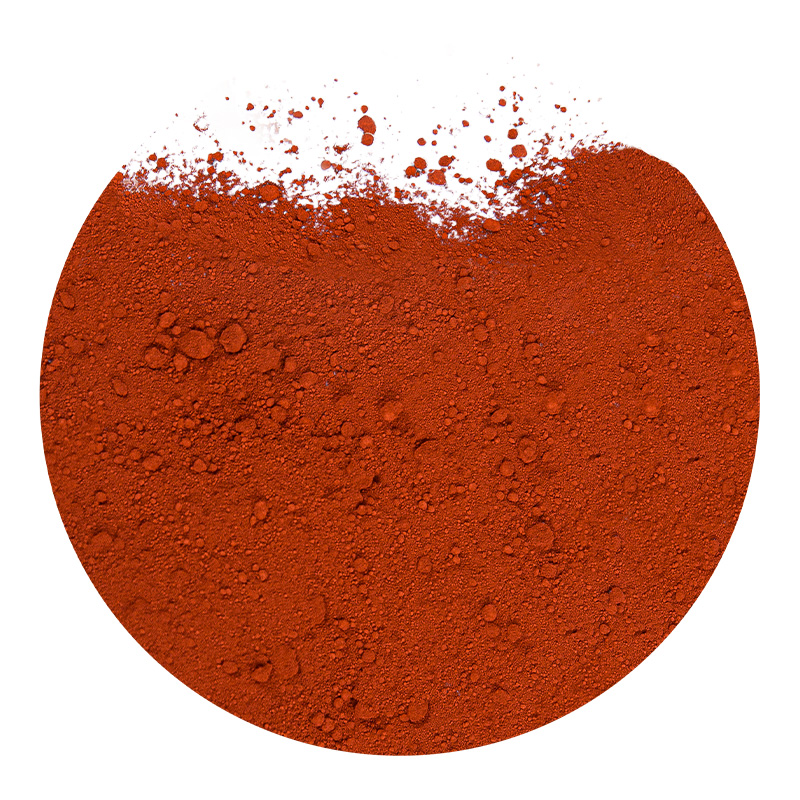 Custom Iron Oxide Pigment Range in Seven ColoursStandard, micronized and low-heavy-metal series across red, yellow, black, brown, orange, green and blue for coatings, plastics, building materials and concrete.View Product →
Price Per Tonne Against Price Per Unit of Colour
A quotation per tonne of Pigment Yellow 42 becomes comparable only after tinting strength is normalised. Two powders at the same price per tonne are not the same purchase when one delivers 92 percent of the colouring power of the other.
Freight and packaging belong in the same calculation. A bag that takes on moisture in transit can cost more in rework and rejected batches than the ocean freight saved on thinner packaging.
Questions Industrial Buyers Ask Before Ordering
Is Pigment Yellow 42 the same as iron oxide yellow 313?
No. Pigment Yellow 42 is the Colour Index definition of synthetic yellow iron oxide. The number 313 is a commercial grade label describing a tinting strength and hue band inside that definition, so two suppliers can both sell PY 42 while delivering products with different colouring power per kilogram.
At what temperature does Pigment Yellow 42 lose its colour?
Dehydration of the goethite lattice starts near 180 °C and becomes visible well before 220 °C. Processes peaking above 200 °C should specify a heat-stable yellow or blend PY 42 with red iron oxide by design rather than by accident.
How much Pigment Yellow 42 is needed to colour concrete?
Integrally coloured concrete normally uses 2 to 8 percent iron oxide pigment by weight of cement, and yellow sits at the upper end of that band because its tinting strength is lower than that of red or black. Confirm the exact dosage with a trial mix against the approved sample.
Can Pigment Yellow 42 be used in cosmetics and food contact?
Yes, in the correct grade. CI 77492 is listed in Annex IV of EU Regulation 1223/2009, and the same iron oxide chemistry is authorised as E172 in the European Union for food use. Both routes require a low-heavy-metal grade supported by per-lot trace element data rather than the standard construction grade.


