English
 عربى
 русский
 Español
Orange Iron Oxide Pigment: Application Requirements & Specs for Industrial Buyers
Content
Orange Iron Oxide Is a Composite, Not a Single Crystal Phase
Orange iron oxide is not defined as a single crystallographic phase under ISO 1248; most commercial grades are controlled composites of red hematite and yellow goethite. Purchasers who specify only a color name accept the production risk, because the phase ratio determines heat ceiling, tint behavior and batch drift.
Dry blending of separately milled red and yellow powders is the lower-cost route and suits concrete and architectural coatings. Co-precipitation and co-milled composites produce a uniform particle population with a single tint response curve, which matters for plastics and high-gloss coatings where two discrete particle families create streaking and gloss differentials.
| Property | Red (hematite) | Yellow (goethite) | Orange (composite) |
| Primary phase | alpha-Fe2O3 | alpha-FeOOH | Fe2O3 plus FeOOH |
| Density | 4.7 - 5.1 g/cm3 | 3.8 - 4.1 g/cm3 | 4.0 - 4.8 g/cm3 |
| Heat stability | above 500°C | 180 - 220°C (dehydration) | 200 - 300°C, yellow-limited |
| Tint character | deep, cool red | clean, light yellow | warm mid-tone, ratio-dependent |
| Main process risk | none below 800°C | darkening above 220°C | phase ratio drift across lots |
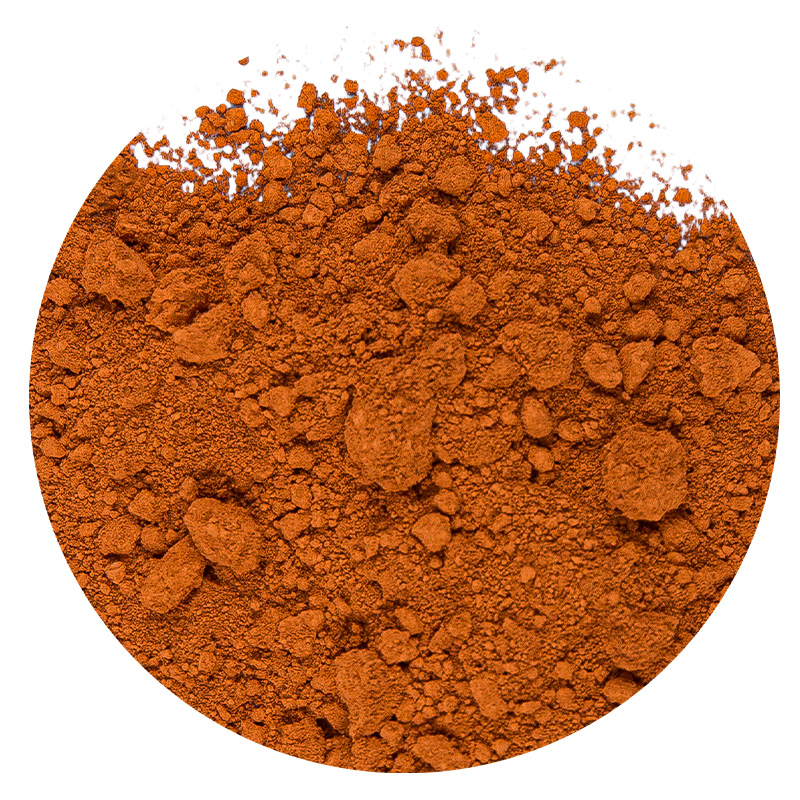 Hydrated Iron Oxide Orange Pigment for Coatings and ConstructionThis inorganic orange pigment is produced via controlled precipitation and calcination, offering lightfastness and alkali resistance. It suits architectural and marine coatings where consistent orange hues and stable performance are required.View Product →
Specify the Batch, Not the Shade
A specification for orange iron oxide must be written around measurable parameters using ISO 787 test methods, because visual shade matching alone does not protect a production line. The seven parameters are oxide content, volatile matter, water-soluble salts, pH, oil absorption, sieve residue and tinting strength.
| Parameter | Test method | Acceptance range |
| Total Fe2O3 content | ISO 1248 | min 85% |
| Volatile matter at 105°C | ISO 787-2 | max 0.5% |
| Water-soluble salts | ISO 787-3 | max 0.3% |
| pH of aqueous extract | ISO 787-9 | 3.0 - 7.0 |
| Oil absorption | ISO 787-5 | 15 - 35 g/100g |
| Residue on 45 µm sieve | ISO 787-7 | max 0.2% |
| Tinting strength vs reference | internal reference | +/- 5% |
Match the Pigment to the Application
Each downstream process demands a different primary property: coatings need weather resistance and tint strength, concrete needs alkali resistance and color uniformity, plastics need heat stability and dispersion, ceramics need a low impurity-oxide profile. The same orange grade will not serve all four optimally.
Coatings
Decisive data: mass-tone and tint-tone stability, accelerated weathering beyond 1,000 hours in QUV or xenon-arc equipment, and a Hegman grind reading of 6 (25 µm or finer).
Plastics
Must survive melt temperature: polypropylene at 230°C and ABS at 240°C push a yellow-phase-limited orange grade to its edge, so a heat-stable red-based composite is safer.
Concrete
Dosage runs at 3 to 7 percent of cement mass, and color must hold in a pore-solution pH above 12.5. Oxide content and sieve residue matter more than oil absorption.
Ceramics
Low chromium, manganese and copper oxide prevent fired color shifts and speckling in glazes fired above 1,000°C. A coatings-grade pigment can fail on these trace oxides.
For the full industry mapping, see the application pages on this site.
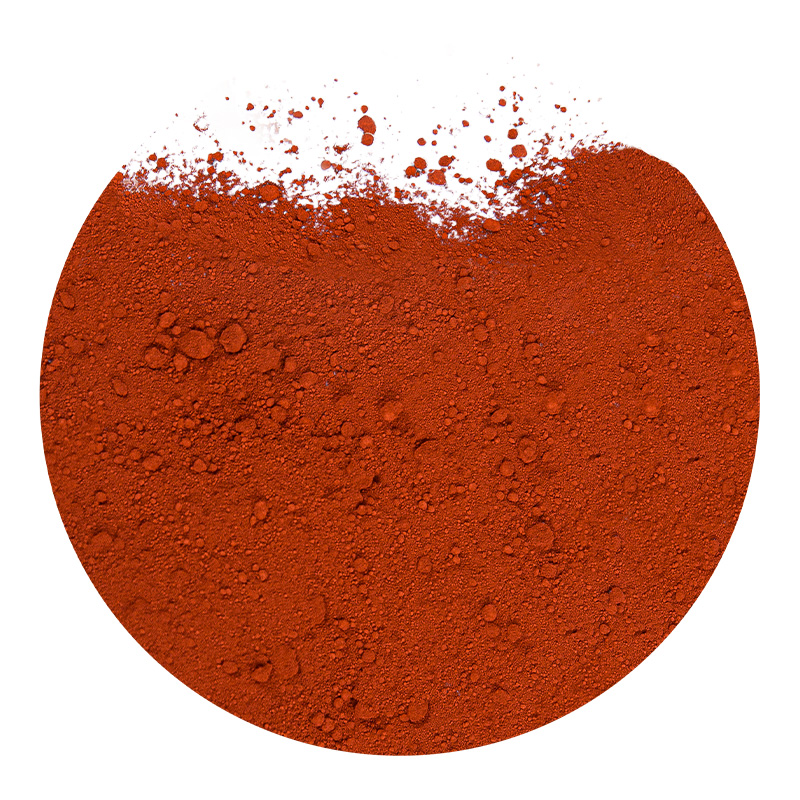 Synthetic and Natural Iron Oxide Red Pigment PowderAvailable in multiple grades with uniform particle size and stable composition, this red pigment suits cement, concrete, and mortar coloring. It offers weather resistance for long-term outdoor use with consistent color tone.View Product →
Lock Down Color Consistency at Receiving
Batch-to-batch color drift beyond ΔE 1.0 in a production tint creates rework and warranty costs that exceed any pigment price saving, so receiving inspection should measure mass tone, tint tone and tinting strength against a locked reference.
- Mass tone versus the approved reference, measured at D65/10 and reported as ΔE.
- Tint tone at a 1:10 pigment-to-titanium dioxide white paste.
- Tinting strength within +/- 5 percent of the reference.
- Residue on a 45 µm sieve and 105°C volatile check matched to the certificate.
- Archival sample of at least 200 g from every lot, retained for 24 months.
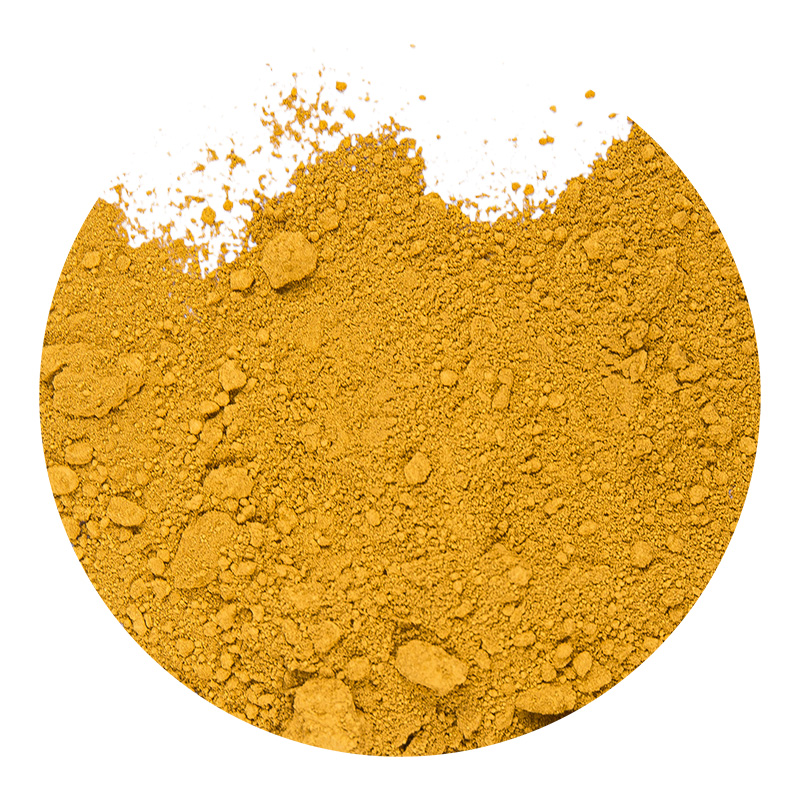 Iron Oxide Yellow Pigment for Concrete and CeramicsThis yellow oxide pigment meets Pigment Yellow 42 standards and is compatible with water- and oil-based media. It provides stable color and particle structure for precast concrete, tiles, and building materials, with minor batch variation.View Product →
Heavy Metal Compliance Decides Who Can Buy
Packaging, toys, food-adjacent materials and electrical enclosures each carry binding limits for hazardous elements, and orange iron oxide must meet EU 94/62/EC, EN 71-3, FDA 21 CFR 73.2250 and RoHS 2011/65/EU. The certificate of analysis must be part of the purchase contract, not a document sent after delivery.
| Standard | Scope | Key requirement |
| EU 94/62/EC | Packaging materials | Pb + Cd + Hg + Cr(VI) sum max 100 mg/kg |
| EN 71-3 (2019) | Toy safety | Migration limits for 19 elements, lead 2.0 mg/kg dry material |
| FDA 21 CFR 73.2250 | Exempt color additive | Iron oxide purity criteria for drug and cosmetic use |
| RoHS 2011/65/EU | Electrical and electronic equipment | Pb max 1000, Cd max 100, Cr(VI) max 1000 mg/kg |
Deqing Demei Pigment Technology Co., Ltd. (Demei) supplies orange iron oxide in standard, micronized and low-heavy-metal series; the low-heavy-metal series is the relevant choice for toys, packaging and food-adjacent uses, with exports across 20 countries.
Supplier Qualification Checklist
A qualified supplier must deliver, with every lot, a certificate of analysis covering oxide content, sieve residue, volatile matter, pH, tint strength and heavy-metal data, plus a written ΔE commitment against the locked reference.
- State the ISO 1248 classification and Fe2O3 content on the packing document.
- Provide a certificate of analysis listing all seven specification parameters with lot values.
- Retain a sealed reference sample of every master lot for 24 months.
- Supply heavy-metal reports from an ISO/IEC 17025 accredited laboratory.
- Maintain traceability from production date to the mill and blender used.
- Pack in laminated PP bags with PE liner so 105°C volatile content stays below 0.5 percent at use.
Specification Answers for Industrial Buyers
Can orange iron oxide be used when the process temperature exceeds 250°C?
Only if the grade has a low yellow-phase content or a red-based composite. Goethite dehydrates above roughly 180-220°C and shifts the color toward red-brown, so polypropylene molding at 230-260°C requires heat-stability data for that exact residence time.
What is a realistic batch-color tolerance for orange iron oxide?
An acceptance limit of ΔE 1.0 against a locked reference in both mass tone and 1:10 tint tone, with tinting strength within +/- 5 percent, is achievable from a consistent synthetic producer; tolerances of ΔE 2.0 or wider transfer color risk to the formulator.
Is orange iron oxide a pure pigment or always a blend?
Most commercial grades are composites of red and yellow phases; a minority are co-precipitated single-synthesis types. The deciding data are color coordinates, phase-sensitive heat ceiling and batch drift history, not the route name.
What storage conditions protect orange iron oxide quality?
Store sealed bags on pallets in dry air below 60 percent relative humidity, keeping 105°C volatile content below 0.5 percent at the mixer. Moisture pickup causes agglomeration and dispersion defects.