English
 عربى
عربى русский
 Español
Pigment Yellow 42 Selection Criteria: A Buyer's Guide for Industrial Users
Content
- 1 Pigment Yellow 42: Chemical Identity and Why It Affects Procurement Decisions
- 2 Six Selection Criteria That Define a Dependable Pigment Yellow 42
- 3 Heat Stability: The Criterion That Eliminates Most Candidate Grades
- 4 Standard, Micronized, and Low-Heavy-Metal Grades: Matching the Grade to the Application
- 5 How to Verify a Supplier's Claims Before You Commit
- 6 Price per Kilogram vs. Cost per Tinted Kilogram
- 7 Practical Buying Questions, Answered Directly
A coatings plant in Guangzhou rejected an incoming Pigment Yellow 42 batch in March 2026 because its tinting strength measured 8 percent below the locked reference sample, even though the certificate of analysis listed the same Fe2O3 content. That gap between documentation and real performance is why procurement teams need verifiable selection criteria before committing to a supplier.
Pigment Yellow 42, C.I. 77492, CAS 51274-00-1, is synthetic goethite (alpha-FeOOH) and the highest-volume inorganic yellow pigment used in architectural coatings, concrete products, plastics, and rubber. This guide gives industrial buyers six measurable selection criteria, the acceptance thresholds that belong in a purchase contract, and the grade architecture that separates commodity supply from process-appropriate supply.
Pigment Yellow 42: Chemical Identity and Why It Affects Procurement Decisions
Pigment Yellow 42 is the standard designation for synthetic iron oxide yellow. Commercial grades assay between 86 percent and 88 percent Fe2O3 on an ignited basis, and ISO 1248, the international specification for iron oxide pigments, sets the class limits used in contract testing. The goethite lattice of Fe3+ with oxygen and one water molecule per formula unit gives the pigment its yellow shade.
Pigment Yellow 42 (alpha-FeOOH) is a synthetic iron oxide hydrate. Its tinting strength and opacity come from acicular, or needle-shaped, particles that scatter and absorb light efficiently, and its lightfastness comes from an iron-oxygen lattice that resists ultraviolet degradation.
Synthetic grades are produced by precipitating iron salts with alkali, then oxidizing and calcining under controlled conditions. This route gives tighter control over particle shape and trace elements than natural yellow ochre, which is why industrial buyers in coatings and plastics specify synthetic Pigment Yellow 42 when batch-to-batch repeatability matters.
Six Selection Criteria That Define a Dependable Pigment Yellow 42
Six measurable criteria determine whether a Pigment Yellow 42 batch will perform in your process: Fe2O3 content, tinting strength, particle size distribution, heat stability, heavy-metal limits, and batch-to-batch color consistency. Each criterion maps to a test method and a numeric acceptance threshold that can be enforced at incoming inspection.
- Fe2O3 content: assays the active pigment mass; low values indicate adulteration or incomplete calcination.
- Tinting strength: measures how much pigment is needed to reach a target color; it directly drives cost per batch.
- Particle size distribution: controls dispersibility, gloss, and opacity; measured by laser diffraction under ISO 13320.
- Heat stability: determines which processes the pigment survives; goethite starts dehydrating near 180 deg C.
- Heavy-metal content: lead, cadmium, mercury, chromium(VI), and arsenic must be controlled for consumer-contact applications.
- Color consistency: expressed as dE against an approved reference sample; contract limits usually sit at dE not exceeding 1.0.
| Criterion | Typical acceptance level | Reference method |
| Fe2O3 content | min 86 percent, ignited basis | ISO 1248 |
| Tinting strength | 95-105 percent of reference | ISO 787-1 |
| Particle size d50 | 0.2-0.5 micron (coatings) | ISO 13320 |
| Heat stability | dE max 2.0 after 30 min at 160 deg C | Oven test |
| Heavy metals | Pb+Cd+Hg+Cr(VI) max 10 ppm | ICP-OES |
| Batch color | dE max 1.0 vs locked sample | CIELAB drawdown |
Buyers who skip tinting-strength testing pay for it twice: once on the scale when the first batch is short, and again when the production line stops for color correction.
Heat Stability: The Criterion That Eliminates Most Candidate Grades
Pigment Yellow 42 cannot be treated as a universal high-temperature pigment. Near 180 deg C, the goethite crystal loses its water of crystallization and transforms into hematite (Pigment Red 101), permanently shifting the shade toward red and darkening the batch. This is a chemical transition, not a surface effect, so no additive can reverse it after it happens.
Thermal transition onset of common iron oxide pigments
The practical consequence: Pigment Yellow 42 is safe in ambient-cure coatings, in powder coatings cured at 160-180 deg C, and in concrete curing at ambient temperature. But engineering plastics processed at 220-260 deg C, coil coatings cured above 230 deg C, and glass enamels fired above 500 deg C need a different pigment or explicit validation from the supplier. State the peak processing temperature in the first line of your inquiry; a supplier that knows its product will tell you whether the grade survives your cure schedule, while a supplier that quotes a generic heat-resistant grade has not tested it.
Standard, Micronized, and Low-Heavy-Metal Grades: Matching the Grade to the Application
Three grade families cover nearly all industrial demand for Pigment Yellow 42: standard grades for concrete and general industrial coatings, micronized grades for high-gloss and low-shear liquid systems, and low-heavy-metal grades for food-contact packaging, cosmetics, and toys. The distinction is particle-size control or purity control, not color.
Choose standard when
- Concrete blocks, pavers, and cementitious render
- Industrial primers and anti-corrosion paints
- Dry hiding matters more than gloss
- Dispersion equipment has long residence time
Choose micronized when
- Coil and automotive coatings
- High-gloss architectural paints
- Short dispersion cycles in high-speed dissolvers
- Film thickness is thin and opacity must stay high
| Property | Standard | Micronized | Low-heavy-metal |
| Typical d50 | 0.3-0.6 micron | 0.1-0.3 micron | 0.3-0.6 micron |
| Dispersion time at 3,000 rpm | 25-40 min | 15-25 min | 25-40 min |
| Common applications | Concrete, primers | Coil, automotive, inks | Food packaging, toys |
| Heavy-metal control | Standard limits | Standard limits | Pb+Cd+Hg+Cr(VI) max 10 ppm |
| Relative price index | 1.0 | 1.15-1.25 | 1.05-1.15 |
Deqing Demei Pigment Technology Co., Ltd. manufactures Pigment Yellow 42 in all three families, with color, particle size, and heavy-metal data verified at production stage.
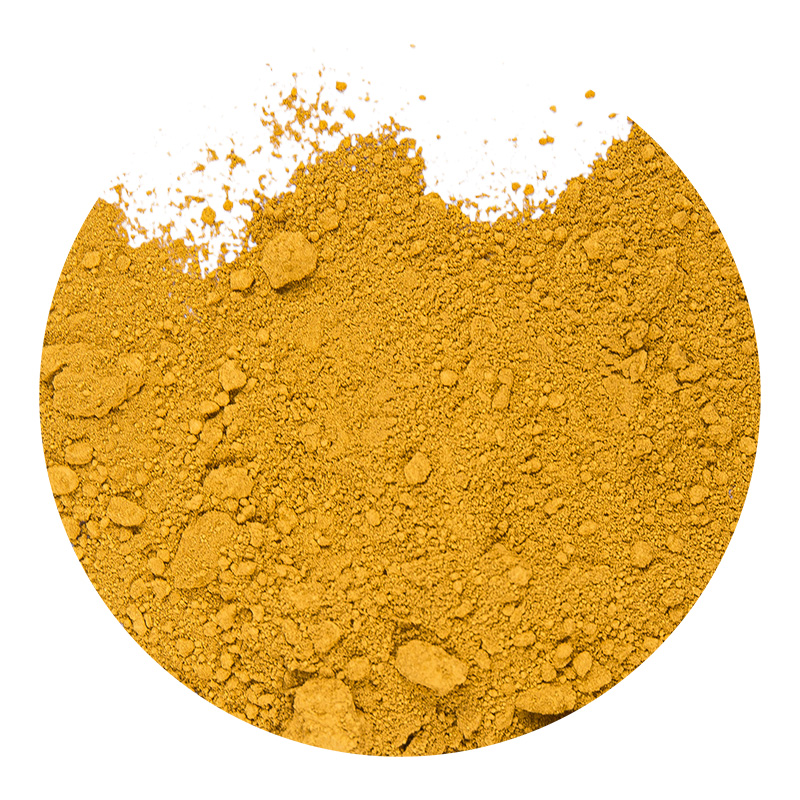 Iron Oxide Yellow Pigment (Pigment Yellow 42) for Concrete and Building MaterialsThis inorganic yellow oxide powder from Deqing Demei offers stable particle structure and uniform size distribution, with specifications like 313, 920, and E172. It suits precast concrete, ceramics, and various colored building surfaces, making it a practical option for procurement teams comparing standard and micronized variants.View Product →
The full iron oxide pigment range is documented on the product index so procurement teams can compare standard and micronized options before requesting samples.
Micronized does not mean purer. It means finer. If your application tolerates a 0.5 micron d50, paying a 20 percent micronization premium adds cost without adding performance.
How to Verify a Supplier's Claims Before You Commit
A certificate of analysis proves only what a supplier measured on one sample; it does not guarantee the next shipment. A four-step incoming inspection, run on every new supplier and quarterly on existing ones, catches most variations before they reach production.
- Lock an approved sample. Keep 500 g of the approved batch sealed in an opaque container; all future evaluations compare against this physical reference.
- Run a drawdown tint test. Disperse the pigment at 10 percent loading in a standard white base, draw down side by side with the reference, and measure dE. Reject if dE exceeds 1.0.
- Check moisture and pH. Moisture above 1.0 percent affects dispersion and can cause particle agglomeration; pH below 3 or above 7 suggests incomplete washing.
- Request batch heavy-metal reports. For regulated markets, demand ICP-OES results for each batch, not a single annual certificate.
For a detailed walk-through of batch-to-batch behavior in a specific grade, read our analysis of Iron Oxide Yellow 313 color consistency and lightfastness.
Price per Kilogram vs. Cost per Tinted Kilogram
The lowest price per kilogram is rarely the lowest cost per finished batch. Tinting strength, moisture content, and dispersion behavior change the real unit cost by 10-20 percent, and buyers who evaluate pigment on price alone almost always switch back after one trial.
Compare two offers. Supplier A charges USD 2.00 per kg at 100 percent tinting strength. Supplier B charges USD 1.80 per kg at 90 percent. To reach the same color strength, you need about 11 percent more of B, lifting its effective cost to USD 2.00 per kg. Add the extra grinding time and the shade-correction risk, and the cheaper quote becomes the more expensive one.
Moisture is the silent cost driver. Iron oxide yellow can absorb 0.5-1.0 percent moisture during humid storage. Buyers who weigh at the silo and mix without correction effectively pay for water at pigment prices.
Request at least 5 kg of free sample from every shortlisted supplier, run the drawdown test from the verification section, and keep the results on file. The supplier that repeats the same results on re-orders is the one worth placing on the approved vendor list.
Practical Buying Questions, Answered Directly
Is Pigment Yellow 42 suitable for exterior architectural coatings?
Yes, provided the grade is a fully calcined synthetic type and the coating is applied at sufficient dry film thickness. Synthetic yellow iron oxide achieves a blue-wool lightfastness rating of 7-8, meaning it holds color for decades in exterior exposure. Do not substitute natural ochre for Pigment Yellow 42; natural grades carry higher silica content and lower tinting strength.
Do Pigment Yellow 42 grades contain heavy metals?
All iron ores contain trace elements, and synthetic production either concentrates or removes them depending on washing depth. Standard grades typically measure combined lead, cadmium, mercury, and chromium(VI) below 20 ppm. Low-heavy-metal grades are controlled to 10 ppm or tighter and comply with EN 71-3 migration limits for toys and EC 1935/2004 for food-contact materials. Ask for the ICP report for every batch.
How should Pigment Yellow 42 be specified in a purchase contract?
Write the requirement as follows: Pigment Yellow 42, C.I. 77492, CAS 51274-00-1, Fe2O3 content min 86 percent on ignited basis, tinting strength 95-105 percent of approved reference, d50 within the agreed range, moisture max 1.0 percent, batch color dE max 1.0 versus locked sample, and heavy metals per the applicable regulation. These clauses remove ambiguity and give your quality team a defensible basis for rejection.
Pigment Yellow 42 is not a commodity that can be bought on price alone. Six criteria, Fe2O3 content, tinting strength, particle size distribution, heat stability, heavy-metal content, and batch consistency, separate a pigment that performs predictably from one that generates rework. Lock a reference sample, put the acceptance thresholds in writing, verify on delivery, and the pigment stops being a variable in your production line.