English
 عربى
عربى русский
 Español
Iron Oxide Red 130: Important Technical Parameters for Industrial Procurement
Content
A procurement manager ordered Iron Oxide Red 130 from three shortlisted suppliers. All three certificates declared an Fe2O3 content above 95%, yet the delivered pigments varied so much in shade strength that the plant had to re-formulate three batches in a row.
The cause was not a fake certificate. It was an incomplete specification. A grade number such as 130 describes a family of pigments, not a single product. The parameters that decide whether the pigment works in your paint, concrete, or plastic process are rarely summarized on a quote page. This guide explains the technical parameters you must verify before ordering, and why a manufacturer's process controls determine whether those parameters hold from lot to lot.
What Iron Oxide Red 130 Is and Why Grade 130 Matters
Iron Oxide Red 130 is a synthetic red iron(III) oxide pigment classified as C.I. Pigment Red 101 (CAS 1309-37-1), with a typical Fe2O3 content of at least 95% and a hematite (alpha-Fe2O3) crystal structure.
Two details matter for procurement. First, the number 130 is a shade and particle size convention used mainly by Chinese producers: within the 110 to 190 range, lower numbers move toward a yellower red and higher numbers toward a bluish or violet red. Grade 130 sits in the middle, with a fine, uniform particle size and good dispersibility, which is why it is the default choice for paints, concrete colorants, and plastics. Second, a synthetic pigment differs from a ground natural oxide. The synthetic route controls crystal growth so that shade, tinting strength, and impurity levels stay stable across production batches.
When you request a quotation, ask the seller to state the crystal phase, the production route, and the D50 range. If a supplier cannot answer these three questions, its other documentation deserves extra scrutiny.
Core Technical Parameters to Verify in a TDS
The parameters that determine delivered value are Fe2O3 content, tinting strength, particle size distribution, oil absorption, pH, moisture, water-soluble salts, and heat stability.
Before comparing price per ton, compare these values on the technical data sheet (TDS). A pigment with lower tinting strength costs more per unit of color, even when its per-kilogram price looks attractive.
The table below lists the full parameter set used for incoming inspection.
| Parameter | Typical value | Why it matters |
| Fe2O3 content | 95% minimum | Sets the upper bound on color strength per kilogram |
| Tinting strength | 95-105 vs standard | Determines your actual formulation cost |
| Particle size D50 | 0.3-0.9 micron | Affects dispersion, gloss, and hiding power |
| Oil absorption | 15-25 g/100g | Drives resin demand in paint and ink systems |
| pH | 4-7 | Compatibility with latex and cement systems |
| Moisture | 0.5% maximum | Prevents clumping and improves storage stability |
| Water-soluble salts | 0.3% maximum | Corrosion and efflorescence risk in coatings and concrete |
| Heat stability | 280-300°C | Safe for most plastics and powder coatings |
| Residue on 325 mesh | 0.05% maximum | Surface defects and filter clogging in fine systems |
| Bulk density | 0.7-1.1 g/cm3 | Packing volume, logistics, and storage planning |
How the Manufacturing Process Controls Batch Consistency
Batch consistency is determined by the production route and process control, not by final inspection alone.
Most commercial Iron Oxide Red 130 is made by one of two routes. In the dry route, ferrous sulfate (copperas) is calcined at high temperature into dense red iron oxide, and the calcination profile controls particle growth and shade. In the wet precipitation route, iron salts are oxidized and precipitated in solution, giving finer particles and more precise tinting strength. A few plants use the Laux process, in which nitrobenzene is reduced to aniline while iron is oxidized, producing very high tinting strength pigments. In every route, the plant must control calcination time, temperature profile, milling, and surface treatment to keep each lot inside the agreed tolerance.
As a manufacturer of inorganic iron oxide pigments, Deqing Demei Pigment Technology Co., Ltd. operates production across the full color range, including red, yellow, black, brown, orange, green, and blue, and offers standard, micronized, and low-heavy-metal series. Vertical integration matters to buyers, because a producer that controls its own calcination and milling can hold shade targets and D50 across lots instead of re-blending purchased powder.
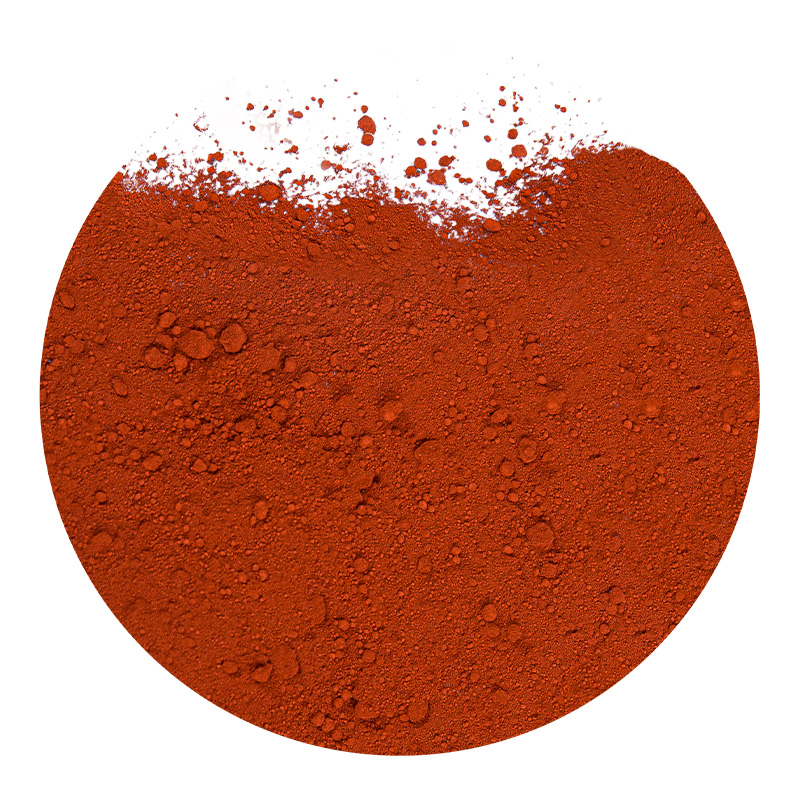 Iron Oxide Red Pigment Powder for Building MaterialsThis product page details iron oxide red grades like 110, 130, and 190, emphasizing uniform particle distribution and stable weather resistance, which supports consistent tinting across concrete and tile production.View Product →
Ask how often shade is measured in production, what lot size the certificate covers, and what tinting tolerance is guaranteed between lots. A manufacturer that answers with numbers will usually deliver them; one that answers with marketing language usually will not.
Parameter Priorities by End-Use Industry
Every application weights the same parameter set differently, which is why a supplier should publish application-specific data instead of a one-line grade description.
Paints and Coatings
Priority goes to D50, dispersibility, weather resistance, and low water-soluble salts. Fine, uniform particles give higher gloss and hiding power, while excessive salts cause flash rusting in waterborne systems.
Concrete and Building Materials
Alkali resistance and tinting strength dominate. The pigment must survive the high pH of wet cement without shade drift, and a high tinting strength lets you use less pigment per ton of concrete.
Plastics and Masterbatch
Heat stability, dispersibility, and moisture decide the outcome. At 280-300°C the pigment is safe for most polymers, but moisture above 0.5% causes steam holes in masterbatch and film.
If your process runs more than one of these systems, request a product family review rather than a single grade. Many manufacturers, including Demei, organize references by industry; see the application guide for concrete, coating, and plastic case data.
A Procurement Checklist for Iron Oxide Red 130
The supplier's documentation is your first control point: request a technical data sheet, a safety data sheet, a batch certificate of analysis (COA), and a shade card measured against an agreed standard before you issue a purchase order.
- Define your shade target against a physical standard sample, not against a screen image.
- Request a pre-shipment sample and run a tinting strength test in your own vehicle (paint, concrete, or plastic).
- Verify D50 and sieve residue on the certificate; if volumes justify it, commission a third-party particle size test.
- Lock the allowed tinting and moisture tolerances into the purchase agreement, not just into the TDS.
- Retain a sealed sample from each lot for incoming inspection and dispute resolution.
For a broader decision framework, our guide on how to choose iron oxide red powder for industrial applications compares price, process, and compliance criteria across typical supplier offers.
Iron Oxide Pigment Supplier with Multiple SeriesThe supplier page showcases standard, micronized, and low-heavy-metal iron oxide pigments, directly relevant for buyers checking shade consistency and regulated heavy-metal limits in downstream applications.View Product →
Finally, check the heavy-metal report. For toys, food-contact packaging, and cosmetics, limits for lead, cadmium, arsenic, mercury, and antimony apply; a low-heavy-metal series designed for those regulated markets is the safer choice.
Frequently Asked Questions
Iron Oxide Red 130 is a dependable workhorse pigment when the specification, documentation, and incoming inspection are aligned.
How does Iron Oxide Red 130 differ from grades 110 and 190?
Grades 110, 130, and 190 form a shade sequence from yellowish red to bluish red. Grade 130 sits in the middle with a fine particle size and good dispersibility, which makes it the typical default for coatings, concrete, and plastics.
What is the heat stability of Iron Oxide Red 130?
Most TDS documents list 280-300°C. That covers nearly all polymers and powder coating cure cycles. If your process exceeds 300°C, verify the specific lot's certificate before purchase.
Which heavy-metal limits apply to Iron Oxide Red 130?
It depends on the market. The EU Toy Safety Directive, FDA food-contact rules for Pigment Red 101, and cosmetic ingredient regulations each set concentration caps for lead, cadmium, arsenic, mercury, and antimony. Request the ICP test report for the exact lot.
Should I test incoming lots of Iron Oxide Red 130?
Yes. Measure moisture, tinting strength against your retained standard sample, and residue on a 325-mesh sieve for every lot. These three tests catch most deviations before the pigment reaches production.