English
 عربى
عربى русский
 Español
Natural Red Oxide vs Synthetic Red Iron Oxide: Key Differences for Industrial Buyers
Content
- 1 What Are Natural Red Oxide and Synthetic Red Iron Oxide?
- 2 Chemical Composition and Physical Form: Where the Real Differences Start
- 3 Tinting Strength, Shade and Hiding Power
- 4 Weathering, Heat Resistance and Chemical Stability
- 5 Cost, Supply Stability and the Hidden Cost of Variation
- 6 Application-by-Application Selection Guide
- 7 Procurement Checklist for Industrial Buyers
A coatings plant's purchasing manager is holding two quotations for the same colour: natural red oxide powder at USD 680 per tonne and synthetic red iron oxide at USD 950 per tonne. The 28% price gap invites an obvious question — is the cheaper material the smarter buy? The attached specification sheets tell a more complicated story. The natural product reports 88% Fe2O3, a D50 of 4.1 µm and a batch-to-batch colour difference (ΔE) of 2.6. The synthetic product reports 96.8% Fe2O3, a D50 of 0.35 µm and a ΔE of 0.8. This article explains what those numbers actually mean for tinting strength, weather resistance, supply risk and finished-product appearance before you commit to a 20-tonne order.
What Are Natural Red Oxide and Synthetic Red Iron Oxide?
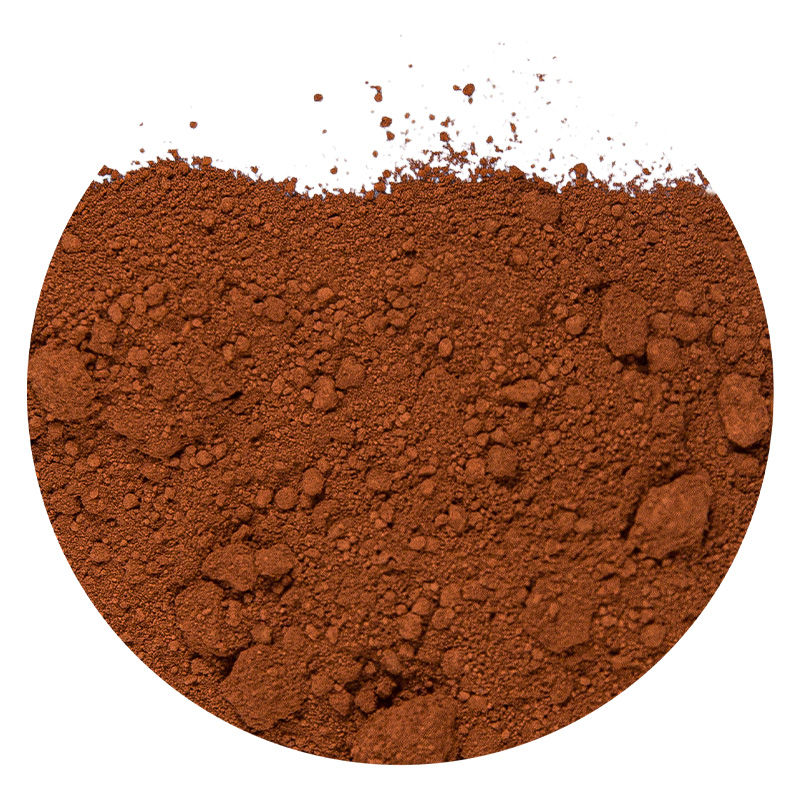
Natural red oxide powder and synthetic red iron oxide share the same chemical identity — α-Fe2O3 — but they differ fundamentally in origin, crystal quality and batch consistency.
Iron ore (primarily hematite) that is crushed, washed, dried and classified. Fe2O3 content typically ranges from 85% to 92%, with SiO2, Al2O3 and Mn oxides present as ore-derived impurities.
Synthetic Red Iron Oxide (C.I. Pigment Red 101)α-Fe2O3 produced by a controlled chemical process such as precipitation or calcination. Under ASTM D3721, synthetic red iron oxide grades typically contain 96% Fe2O3 or higher.
The origin difference drives four practical consequences for buyers:
- Purity: natural ore concentrates carry mineral impurities; synthetic pigment carries only process-related salts.
- Crystal form: natural hematite has an irregular mined crystal habit; synthetic pigment grows controlled acicular or spherical crystals.
- Particle size: natural milling rarely goes below 2 µm; synthetic precipitation can hold D50 between 0.2 and 0.6 µm.
- Consistency: ore bodies change with the mining face; a chemical reactor does not.
For a broader look at how these differences appear across the wider pigment family, see our earlier comparison of synthetic and natural iron oxide pigments.
Chemical Composition and Physical Form: Where the Real Differences Start
The most measurable difference is particle size distribution. Synthetic PR 101 is precipitated or milled to a D50 of 0.2–0.6 µm, while natural red oxide powders typically sit at 2–10 µm after beneficiation. Smaller particles mean more surface area per gram, which directly translates into higher tinting strength and cleaner dispersion in the binder.
| Parameter | Natural Red Oxide | Synthetic PR 101 |
| Fe2O3 content | 85–92% | 96–99% |
| Typical impurities | SiO2, Al2O3, MnO, combined water | Trace sulfate, chloride, process salts |
| Crystal morphology | Irregular natural hematite | Acicular or spherical, controlled |
| Typical D50 | 2–10 µm | 0.2–0.6 µm |
| Specific surface area | 1–3 m2/g | 8–15 m2/g |
| Batch colour difference (ΔE) | 2.0–3.5 | 0.5–1.0 |
Impurities matter beyond the certificate numbers. Silica and alumina increase abrasiveness in processing equipment. Manganese oxides darken the shade at elevated curing temperatures. And combined water in some natural ores affects dispersion stability in solvent-borne coatings. Synthetic pigment, because it is built from purified feedstock, avoids most of these variables.
Tinting Strength, Shade and Hiding Power
At equal addition levels, synthetic red iron oxide delivers roughly 20–30% higher tinting strength than natural red oxide powder. That means a formulator can reach the same CIELab target with less pigment — a factor that narrows the raw price gap on a cost-per-unit-of-colour basis.
The visual consequences are straightforward: a synthetic PR 101 paint reaches full opacity at lower film thickness, keeps a cleaner red undertone, and stays closer to the approved colour standard when production runs are compared side by side.
Weathering, Heat Resistance and Chemical Stability
Both pigment classes perform well outdoors, but synthetic grades deliver more predictable behaviour in heat, alkali and heavy-metal testing because the impurity profile is controlled by the production process rather than by the ore deposit.
In a 300 °C / 2 h heat exposure, high-purity synthetic PR 101 typically shifts less than 1.5 ΔE, while manganese-bearing natural red oxide can shift more than 3.0 ΔE under the same conditions. For powder coating and plastic masterbatch processors that is the difference between a pass and a reformulation.
- UV stability: both types are strong in exterior architectural coatings, with 20+ year service records.
- Heat stability: synthetic versions are the standard choice for cure cycles above 180 °C.
- Alkali stability: in Portland cement both survive well; natural grades with high silica can increase efflorescence risk in some mixes.
- Heavy-metal limits: synthetic low-heavy-metal grades can meet FDA 21 CFR 178.3297 and similar limits; natural grades depend entirely on the mine's geology.
Cost, Supply Stability and the Hidden Cost of Variation
Natural red oxide costs 20–35% less per tonne, but batch variability adds rework, colour-correction labour and customer concessions that can erase the price advantage over a full production season.
Mine output drifts as the mining face moves; a single pallet can vary by 2.0–3.5 ΔE from the previous shipment. In a 10-tonne order, that forces every batch through a fresh shade adjustment. Synthetic PR 101, by contrast, comes from a reactor with a fixed recipe, which is why manufacturers such as Deqing Demei Pigment Technology Co., Ltd. offer iron oxide red in three series — standard, micronized and low-heavy-metal — with a defined specification window for each.
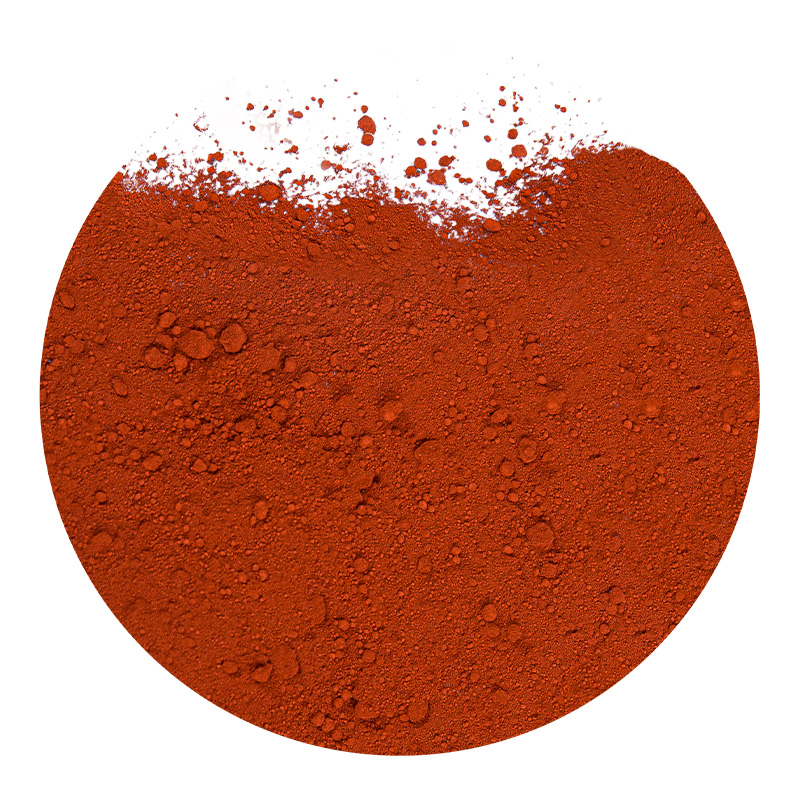 Synthetic and Natural Iron Oxide Red Pigment GradesThis pigment range includes standard, micronized, and low-heavy-metal series with defined specifications, offering stable color and weather resistance for building materials and concrete applications.View Product →
Supply terms also differ. Natural oxide is tied to mine logistics, seasonal material handling and beneficiation capacity. Synthetic production runs against order cycles but with significantly lower colour-shade risk and a more predictable lead time.
Application-by-Application Selection Guide
Choosing natural or synthetic is not a budget question — it is a material specification question. For mass-coloured concrete, interlocking pavers and roofing tiles, natural red oxide at 3–5% dosage is often sufficient. For automotive coatings, powder coatings, plastics and ceramic inks, synthetic PR 101 is the only defensible choice when shade tolerance is tight.
Natural red oxide works when
- Colour target is a utilitarian red or brown, not a saturated red
- Concrete or mortar allows a ±2.0 ΔE tolerance
- Cost per tonne is the deciding metric
- No heat cycle above 180 °C occurs after pigmentation
Synthetic PR 101 works when
- Batch-to-batch consistency matters in the final product
- Heat curing, powder coating or plastic processing is involved
- Heavy-metal or food-contact compliance is required
- Higher tinting strength must reduce total pigment loading
For a practical map of where iron oxide pigments enter industrial production, see our application overview.
Procurement Checklist for Industrial Buyers
A defensible purchase specification for red iron oxide should include Fe2O3 content, D50, 325-mesh sieve residue, ΔE against an agreed reference sample, and a heavy-metal limit aligned to your destination market.
- Require a certificate of analysis with every lot — specifically Fe2O3, D50 and 325-mesh residue.
- Set a ΔE upper limit versus your master standard: 1.0 for synthetic, 2.0 for natural, and hold the supplier liable for exceeding it.
- Verify heavy metals (Pb, Cd, Hg, As) with a third-party ICP report when the pigment contacts food or cosmetics.
- Compare price on tinting-strength-adjusted cost, not price per tonne.
- Confirm the supplier's production route — reactor-processed synthetic pigment gives a fundamentally different consistency profile than ore beneficiation.
Can natural red oxide powder replace synthetic red iron oxide in concrete?
Yes, for mass-coloured concrete where the target is a stable earth tone. Natural red oxide at 3–5% dosage is a proven, economical choice for pavers, blocks, roof tiles and mortar. The replacement fails when the specification demands tight shade tolerance, low heavy metals or consistent colour under a defined curing cycle — that is where synthetic PR 101 remains essential.
How much synthetic red iron oxide do I need to match natural oxide colour strength?
Typically 20–30% less, by weight, to achieve the same CIELab target in the same binder. The exact reduction depends on the natural powder's particle size and Fe2O3 content; a coarse 88% natural grade requires the largest correction, while a fine 92% grade narrows the gap.
What does ΔE mean when comparing pigment batches?
ΔE expresses total colour difference in the CIELab system. ΔE below 1.0 is barely visible under standard lighting; 1.0–2.0 is noticeable on close inspection; above 2.0 is visible in most outdoor applications. Synthetic PR 101 typically holds ΔE between 0.5 and 1.0, while natural grades range from 2.0 to 3.5 unless the mine is unusually uniform.
Is synthetic red iron oxide always the right choice for regulated products?
Not automatically. Regulatory compliance depends on the specific grade, not on the synthetic or natural label. In practice, synthetic routes are easier to certify because heavy metals can be removed during precipitation; a low-heavy-metal synthetic grade that meets FDA 21 CFR 178.3297 for polymers is readily available from major producers. Natural grades must be tested lot by lot because mineral impurities vary with the ore body.