English
 عربى
عربى русский
 Español
Black Iron Oxide E172: Complete Guide to Properties, Uses, and Food-Grade Selection
Content
What Is Black Iron Oxide E172
Black iron oxide E172 is the European food-additive designation for synthetic magnetite (Fe3O4), identified as Pigment Black 11 (CI 77499) and governed by purity specifications that industrial pigments are not required to meet.
The E172 category covers three iron oxides: black (Fe3O4), red (Fe2O3), and yellow (FeO(OH)). Black is the only mixed-valence member, containing both ferrous and ferric iron in each unit cell. This structure yields a deep black hue, a density near 4.95 g/cm3, and a slight ferrimagnetic response. Commercial synthetic grades typically have a mean particle size of 0.2 to 0.6 micrometers.
| Parameter | Typical value | Relevance |
| Chemical formula | Fe3O4 | Confirms the oxide form |
| Color Index | Pigment Black 11 (CI 77499) | International colorant identification |
| CAS number | 1317-61-9 | Registry and safety data sheets |
| Specific gravity | Approx. 4.95 g/cm3 | Suspension and settling behavior |
| Mean particle size | 0.2-0.6 micrometers | Tinting strength and dispersibility |
| Onset of oxidation in air | Above 250 C | Color stability during processing |
| Alkaline media resistance | Excellent | Concrete and masonry applications |
| Lightfastness | 7 to 8 on blue wool scale | Exterior color retention |
Food-Grade E172 vs Industrial-Grade Black Iron Oxide
Food-grade and industrial-grade black iron oxide share the same crystal structure; the distinction lies in trace impurities, regulated heavy metals, and the compliance documents that prove a material meets a food-additive specification.
Natural magnetite ores often contain chromium, nickel, and copper, and the levels vary from deposit to deposit. Synthetic routes let the manufacturer control impurities from the start. E172-qualified production requires dedicated equipment, raw-material screening, and per-batch testing against limits such as:
- Lead: not more than 10 mg/kg under the EU iron oxide specification
- Arsenic: not more than 3 mg/kg
- Mercury: not more than 1 mg/kg
- Cadmium: not more than 1 mg/kg
Food-grade E172
- Per-batch heavy metal certificate expected
- Compliance with EU 231/2012 or equivalent national standard
- Traceability from raw material to finished lot
- Higher cost, typically 30 to 50 percent above industrial grade
Industrial-grade black iron oxide
- Color strength and dispersion are the main quality targets
- Heavy metals not routinely controlled
- No food-contact compliance documentation
- Lower cost per kilogram, unsuitable for food or cosmetics
If the target application involves food contact, the buying criteria change completely. The walkthrough on choosing black iron oxide E172 for food coloring covers dosage, labeling, and regulatory checks.
Processing Properties That Determine Performance
Four properties determine performance: thermal stability, alkali resistance, lightfastness, and particle-size distribution.
Thermal stability
In air, oxidation of Fe3O4 toward Fe2O3 becomes measurable above roughly 250 C. In oxygen-limited polymer melts, the pigment stays stable through normal 200-250 C processing and tolerates short excursions near 280 C. That is why polypropylene and polyethylene masterbatch producers rely on it.
Alkali resistance
In cementitious environments at pH 12 to 13, Fe3O4 shows negligible color loss and no interference with hydration. Concrete pavers, roof tiles, and masonry use it as the default black.
Lightfastness
A blue wool rating of 7 to 8 means decades of color retention in exterior coatings.
Particle-size distribution
Standard grades run 0.2 to 0.6 micrometers mean size. Micronized grades disperse faster but raise oil absorption and binder demand; in paint formulation, finer is not always better. Suppliers offering separate standard, micronized, and low-heavy-metal series make this choice explicit, because each family targets a different formulation profile.
When comparing spot offers, check sieve residue, mean particle size, and dispersion data, not just price. The black iron oxide pigment series by Deqing Demei Pigment Technology Co., Ltd. documents these values per lot.
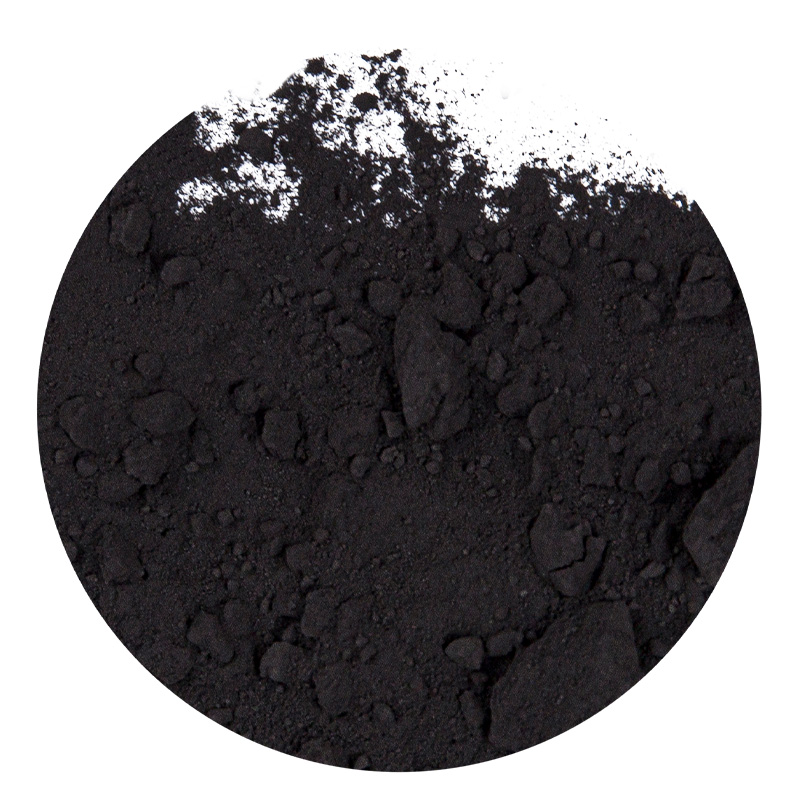 Custom Black Oxide Powder, Black Iron Oxide Pigment SuppliersDeqing Demi: China Black Oxide Powder, Black Iron Oxide Pigment Manufacturers, Suppliers, Factory, We Wholesale Custom Iron Oxide Black E...View Product →
Application Range Across Industries
Black iron oxide E172 appears across five sectors, and the purity grade matters in each one: construction uses industrial Fe3O4, while cosmetics and food require controlled forms of the same crystal structure.
- Construction and building materials: concrete pavers, roof tiles, and ready-mixed color where alkali resistance and UV permanence are mandatory.
- Coatings and paints: primers, wood stains, and industrial finishes needing a chemically inert black with high hiding power.
- Plastics and polymers: masterbatch, films, pipes, and automotive parts processed below 250 C.
- Cosmetics and personal care: mascara, eyeliner, eyebrow powder, and eyeshadow formulated with CI 77499.
- Food products: confectionery coatings, dessert powders, and selected dairy uses where E172 appears on the label.
The manufacturer's pigment application overview groups products by end-use industry, shortlisting the right grade before you send an inquiry.
In cosmetics and food, the colorant must match the purity standard of the destination market. A batch that passes the EU E172 limits may not automatically satisfy every requirement of the US FDA regulation for the same colorant. Confirm the destination standard when you order.
Buying Black Iron Oxide E172: What to Verify
Before approving a new supplier, verify five things. The certificate of analysis is the most important: without per-batch heavy metal data, an E172 claim is unproven.
- Request the certificate of analysis for the exact batch you intend to buy, not a representative data sheet.
- Match every quoted limit against the standard for the destination market, whether EU 231/2012, FCC, or an equivalent national specification.
- Confirm the production route. Synthetic precipitation followed by calcination delivers far more consistent heavy-metal control than ground natural ore.
- Inspect bulk density, sieve residue, and moisture values to rule out handling and storage problems.
- Check the packaging line. Food-grade material must be stored in clean dedicated bags, and any cross-contamination destroys compliance.
Deqing Demei Pigment Technology Co., Ltd. publishes factory background and the complete pigment lineup on the official company site, so you can confirm the manufacturing setup before contacting sales.
The complete seven-color iron oxide range is available from the product category page, where each color family links to its own technical data.
 Custom Iron Oxide Pigment Suppliers, ManufacturersDeqing Demei Pigment Technology Co., Ltd. Is China Iron Oxide Pigment Suppliers, Manufacturers And Iron Oxide Pigment Factory, We Offer c...View Product →
Frequently Asked Questions
Is black iron oxide E172 the same as Pigment Black 11?
Yes, from different angles. E172 is the European food-additive code for iron oxides, while Pigment Black 11 (CI 77499) is the Color Index name used in coatings, plastics, and cosmetics. A food-grade lot must satisfy both the colorant identity and the purity limits of the relevant food-additive standard.
Can one E172 batch be used for both food coloring and industrial paints?
A lot certified to E172 can also serve as an industrial colorant if its color properties fit the formulation. The reverse is not true: an industrial batch without food-grade evidence cannot enter food. Many manufacturers run dual tracking, with food-certified lots commanding a premium and industrial lots following separate specifications.
What documents should I request when verifying E172 compliance?
Request four documents: the certificate of analysis for the specific batch, a declaration of conformity to the applied standard, a summary of the production route, and the most recent third-party heavy metal testing report.
How much more does food-grade E172 cost than industrial black iron oxide?
Pricing varies with volume and logistics, but food-grade material commonly runs 30 to 50 percent higher than industrial pigment. The premium covers controlled raw materials, dedicated equipment, per-batch testing, and compliance documentation.