English
 عربى
 русский
 Español
Orange Iron Oxide Pigment: Application Requirements for Industrial Manufacturers
Content
- 1 What Orange Iron Oxide Pigment Is in Specification Terms
- 2 The Acceptance Numbers to Write Into the Specification
- 3 Heat Exposure: Where Orange Pigment Sets Its Own Ceiling
- 4 Single-Phase or Blended Orange: The Segregation Question
- 5 Application Requirements by Industry
- 6 Packaging, Documentation and the Order That Protects You
- 7 Practical Questions Before You Place the Order
Orange iron oxide pigment sits exactly where two iron oxide chemistries meet: hematite red (Fe2O3) and goethite yellow (FeOOH). Industrial manufacturers rarely lose a batch because the colour is wrong on arrival. They lose it because the shade drifts inside the extruder, bleeds out as efflorescence on a paver face, or swings toward red in an oven set to 230 degrees Celsius.
For industrial manufacturing, an orange grade has to clear four hard numbers before price becomes relevant: a practical heat ceiling near 180 degrees Celsius wherever a goethite fraction is present, a dosage window of roughly 2 to 8 percent by weight of cement in cement-bound products, moisture at or below 1.0 percent, and batch-to-batch tinting strength held within 5 percent of the agreed reference.
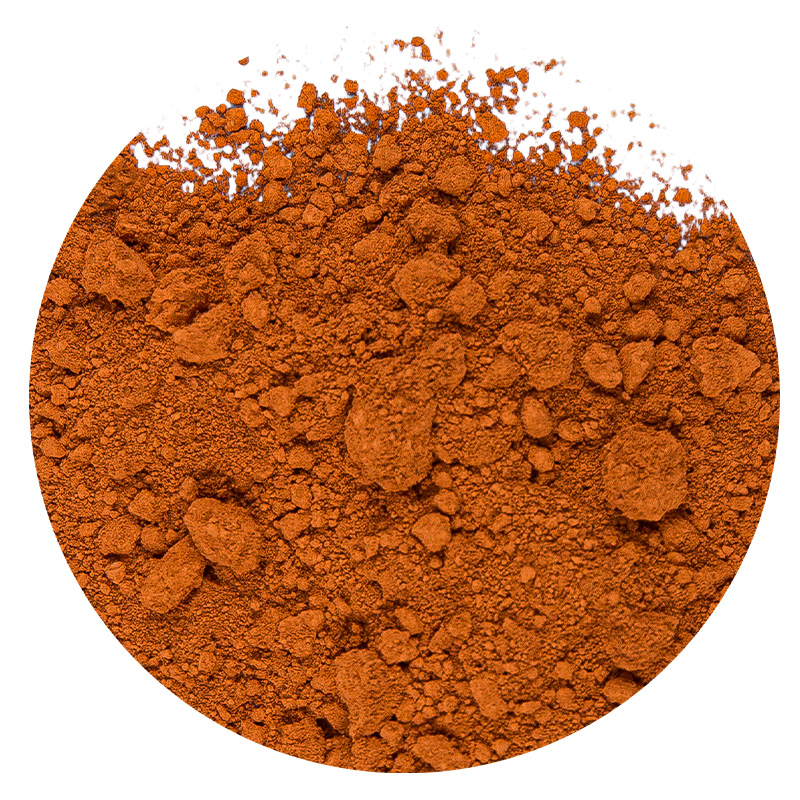 Iron Oxide Orange Pigment Grades 960 and 2040Review these orange iron oxide grades for cement-bound products, coatings, plastics, and rubber, with specifications covering moisture, tinting strength, and heat resistance to 160°C.View Product →
The pages that follow are written from the buyer's side of the table: which parameters belong in a purchase specification, which test methods prove them, and where an orange grade fails even when the certificate of analysis looks clean.
What Orange Iron Oxide Pigment Is in Specification Terms
Orange iron oxide pigment is a synthetic inorganic colourant in which red hematite (C.I. Pigment Red 101) and yellow goethite (C.I. Pigment Yellow 42) are combined to produce hues between the two, with lightfastness of 7 to 8 on the blue wool scale and no solubility in water or in common organic solvents.
Definition: an orange iron oxide pigment is any colourant whose hue comes from iron oxide chemistry alone, with no organic dye or lake added, and whose orange tone is produced either by co-precipitating the red and yellow phases into one crystal habit or by blending the two grades to a target shade.
That distinction decides which properties a buyer can hold a supplier to. A co-precipitated grade is sold as one pigment with one set of numbers. A blended grade carries two sets of numbers, and both have to be checked.
- Lightfastness and weathering: iron oxide pigments score 7 to 8 on the blue wool scale, so exterior concrete, facade renders and road markings hold colour under UV exposure that fades organic pigments far sooner.
- Alkali resistance: uncoated iron oxide withstands the pH 12 to 13 pore solution of fresh cement, which is why cement-bound colour does not bleach during curing.
- Thermal ceiling: any goethite fraction begins losing chemically bound water at about 180 degrees Celsius and converts toward hematite red.
- Density: 4.0 to 5.2 g/cm3 depending on the phase mix, which is high enough to matter in pneumatic conveying and in liquid paint settling.
- Oil absorption: commonly 15 to 30 g per 100 g, which drives binder demand in solvent-borne and water-borne coatings.
Supply format belongs in the specification too. Manufacturers such as Deqing Demei Pigment Technology Co., Ltd., based in Deqing, Zhejiang Province, China, offer the same orange hue as standard, micronised and low heavy-metal series, and those three series behave differently in a mixer. Buyers comparing synthetic orange iron oxide pigments should confirm which series a quotation covers before comparing price per tonne.
The Acceptance Numbers to Write Into the Specification
Four numbers decide whether an orange iron oxide lot is accepted: tinting strength within 5 percent of the agreed reference, moisture at or below 1.0 percent, sieve residue at or below 0.1 percent on a 45 micron sieve, and water-soluble salt content low enough to satisfy EN 12878 for cement-bound building materials.
| Parameter | Typical requirement | Why it matters | Reference method |
| Tinting strength | Within 5 percent of agreed reference | Shade drift across bulk pours and repeat orders | ISO 787-24 |
| Moisture content | 1.0 percent maximum | Caking in silos, dosing error, steam defects in extrusion | ISO 787-2 |
| Residue on 45 micron sieve | 0.1 percent maximum | Screen and filter blocking, specking in thin films | ISO 787-7 |
| pH of aqueous extract | 5 to 8 | Pot life and binder compatibility | ISO 787-9 |
| Water-soluble salts | Per EN 12878 limits | Efflorescence on pavers, corrosion risk in reinforced concrete | EN 12878 |
| Heavy metals | Declared where child contact applies | Regulatory clearance for toys, play surfaces, consumer goods | EN 71-3 |
EN 12878 is the harmonised European standard for pigments used to colour building materials based on cement and lime, and compliant grades ship with a Declaration of Performance and CE marking. In the United States, ASTM C979 covers pigments for integrally coloured concrete. Both standards exist for the same reason: water-soluble salts in a pigment cause efflorescence and attack embedded steel.
Heat Exposure: Where Orange Pigment Sets Its Own Ceiling
The goethite fraction in an orange grade begins to dehydrate at about 180 degrees Celsius, so any process running hotter than roughly 180 to 200 degrees Celsius will see the shade move toward red unless the supplier provides test data measured at the actual process temperature.
This is the most common technical surprise for manufacturers moving from a red pigment to an orange one. Polypropylene and polyamide are extruded at 220 to 260 degrees Celsius. Powder coating ovens cure at 180 to 200 degrees Celsius for 10 to 15 minutes. Both sit on or beyond the ceiling, and neither will forgive a grade that was only tested at ambient conditions.
Iron oxide yellow is the phase that sets that ceiling, so the heat stability figures quoted for a yellow grade are the ones worth comparing against your own process window.
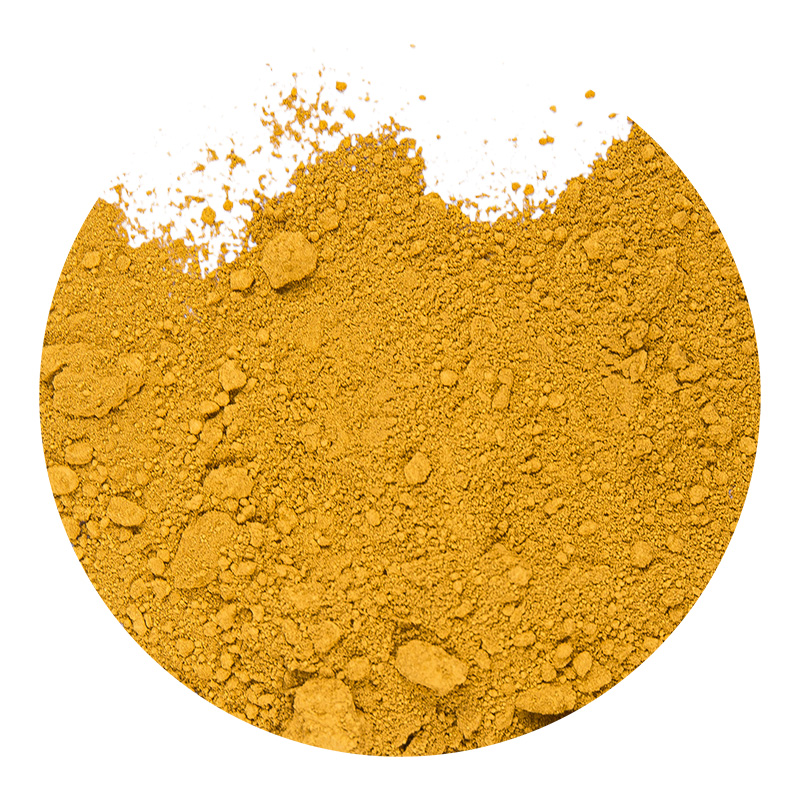 Iron Oxide Yellow Pigment Grades 313, 920, and E172Compare yellow iron oxide grades for heat stability, including 313 up to 240°C, alongside 920 and E172 for coatings, cement, rubber, and food-contact uses.View Product →
Ceramic and enamel producers face a harder limit. Firing at 1,000 to 1,200 degrees Celsius destroys an iron oxide orange body completely, because the pigment has no lattice to hide in. Those applications need iron-zircon orange pigments, in which the colour is encapsulated inside a zirconium silicate structure that survives the kiln.
Single-Phase or Blended Orange: The Segregation Question
Co-precipitated single-phase orange holds hue more tightly and cannot segregate, while a physical red-yellow blend can separate during pneumatic conveying and vibration because hematite sits near 5.0 g/cm3 and goethite near 4.0 g/cm3.
- One set of specification values for the whole colour
- No segregation risk in dry mixes, conveying lines or bulk bags
- Tighter batch-to-batch hue control, the usual choice for repeat architectural shades
- Higher cost per tonne and a shorter supplier list
- Any shade between red and yellow can be dialled in without a new production run
- Lower cost and wider availability from more suppliers
- Segregation risk when densities differ and the components are not bonded or micronised together
- Two certificates of analysis to manage instead of one
Field verification is simple and worth the afternoon it costs. Draw samples from the top, middle and bottom of one delivered pallet, measure tinting strength on each, and compare. If the spread exceeds 5 percent, the blend is separating somewhere between the supplier's plant and your silo.
Where a blend is unavoidable, the red component sets the final depth of shade, so its tinting strength and density deserve the same scrutiny as the orange itself.
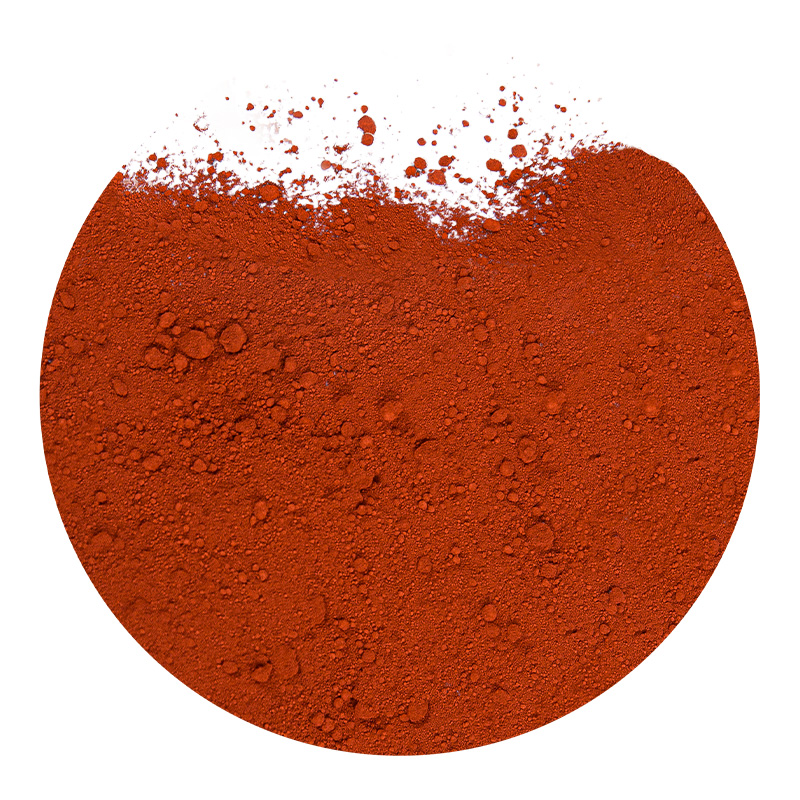 Iron Oxide Red Pigment Grades 110, 130, and 190Check red iron oxide grades for tinting strength, density, and batch consistency when adjusting shade depth in cement, coatings, plastics, and rubber.View Product →
Application Requirements by Industry
Dosage and tolerance requirements for orange iron oxide pigment change with the carrier: 2 to 8 percent by weight of cement for precast pavers and blocks, 1 to 5 percent for ready-mix and industrial floors, and heat-stable alternatives for any ceramic process firing above 1,000 degrees Celsius.
| Application | Critical requirement | Typical addition | Watch item |
| Precast pavers, blocks, roof tiles | Stable tinting strength, low water-soluble salts | 2 to 8 percent of cement weight | Efflorescence on the face mix |
| Ready-mix concrete and industrial floors | Dispersion in the mixer, no streaking | 1 to 5 percent of cement weight | Segregation in transit |
| Dry-mix render, plaster, pointing mortar | Uniform dry blend with the binder | 1 to 3 percent of binder weight | Colour drift between pallets |
| Coloured asphalt and surface treatments | Resistance to binder and mixing temperature | Set by mix trial | Hue shift at mixer discharge |
| Plastics and masterbatch | Heat stability at process temperature | Set by trial at melt temperature | Yellow phase converting to red |
| Ceramic bodies and glazes | Kiln stability above 1,000 degrees Celsius | Not applicable to iron oxide orange | Use iron-zircon orange instead |
For cement-bound work, pigment is only one of three inputs that decide the final colour. Cement grey level, sand colour and water content move the result as much as the pigment does. Manufacturers who test pigments powder for concrete and mortar against their own mix, rather than against a laboratory standard, avoid the most expensive mistake in this category.
Packaging, Documentation and the Order That Protects You
A purchase order for orange iron oxide pigment should carry five documents and two packaging facts: a certificate of analysis for each production lot, a safety data sheet in GHS format, a heavy-metal declaration, a Declaration of Performance where EN 12878 applies, and a retained sample reference, plus the bag format and the net weight per pallet.
- Certificate of analysis per lot: tinting strength, moisture, sieve residue, pH and heavy metal figures, tied to a production lot code printed on the bag.
- Safety data sheet: GHS classification plus handling and storage data for warehouse staff.
- Packaging: 25 kg polyethylene-lined multiwall paper bags, or 1,000 kg FIBC bulk bags with discharge spouts, on 1,000 to 1,250 kg pallets.
- Loading: a 20 ft container carries roughly 20 to 25 metric tonnes of 25 kg bags, which sets landed cost per tonne more than the ex-works price does.
- Customs: iron oxides and iron hydroxides fall under HS code 2821.10, so the broker should be working from that heading.
Practical Questions Before You Place the Order
What dosage should a concrete paver producer use?
Start at 3 percent by weight of cement and increase in 0.5 percent steps until the target shade is met. Most pavers and blocks land between 2 and 8 percent. Pigment above 8 percent rarely deepens the colour further and only adds cost to the mix.
Can orange iron oxide pigment be used in plastics processed above 200 degrees Celsius?
Only with documented heat-stability data from the supplier at your melt temperature. Goethite dehydrates near 180 degrees Celsius, so an unverified grade will shift toward red during extrusion, and that shift is not reversible by adjusting the colour card.
How do I verify batch consistency before a bulk order?
Request certificates of analysis for three consecutive lots and compare tinting strength, moisture and sieve residue across them, then test 5 kg of each lot in your own mixer or extruder. If the three lots hold within 5 percent tinting strength and 1.0 percent moisture, the supplier's production process is under control.
Is orange iron oxide pigment compliant with EN 12878?
Yes, when the grade is certified to that standard. EN 12878 covers pigments for colouring building materials based on cement and lime and sets limits on water-soluble salts. Compliant grades ship with a Declaration of Performance and CE marking, so request the DoP before the first delivery rather than after.