English
 عربى
 русский
 Español
Brown Iron Oxide Powder: How to Evaluate Color Strength and Dispersion Performance
Content
- 1 What Color Strength Actually Means for Brown Iron Oxide Powder
- 2 Why Dispersion Performance Decides Your Final Surface Quality
- 3 Test Methods You Can Run Before Purchase
- 4 Red Flags and Supply Risks to Check in a New Batch
- 5 How to Ask the Right Questions to Your Manufacturer
- 6 Frequently Asked Questions
- 6.1 What is the difference between color strength and tinting strength in brown iron oxide powder?
- 6.2 How much dispersion do I need for a brown iron oxide in an architectural coating?
- 6.3 Can I compensate for low tinting strength by adding more pigment?
- 6.4 What factors affect the dispersion performance of brown iron oxide powder?
A paint formulator opening a 25 kg bag of brown iron oxide powder from a new supplier is often surprised when the first lab drawdown looks nothing like the reference panel. The hue matches, but the tinting strength reads 15 percent lower, and the grindometer shows coarse agglomerates that will not collapse in a high-speed disperser. This is the moment when spec sheets stop being paperwork and become a practical evaluation problem.
Color strength is the relative ability of a pigment to increase the color intensity of a base system when mixed with a white or colored standard; it is determined by the pigment's particle size distribution, crystal structure, and surface chemistry.
What Color Strength Actually Means for Brown Iron Oxide Powder
Color strength is not a single number. It is a performance measure tied to how effectively a pigment contributes chroma to a binder system, and it shifts depending on whether you measure mass tone or tinting strength. For brown iron oxide, this distinction is critical because the pigment is rarely used alone. It is almost always blended into a base that already contains white, yellow, or black pigments.
When a paint maker switches from one brown iron oxide powder to another, the first practical question is whether the new lot reaches the same tinting strength as the reference standard. A 10-15 percent drop in tinting strength usually means the batch needs more pigment to hit the target shade, which changes both cost and hiding power. With a plant batch of 500 liters, that extra pigment can add several hundred dollars per production cycle.
Brown iron oxide pigments are typically evaluated in the CIELAB color space, where L* stands for lightness, a* for the green-red axis, and b* for the blue-yellow axis.
| Assessment | What it shows | Typical method |
| Mass tone | The pigment's own color appearance at a defined pigment-to-binder ratio | Drawdown over black or white scrub panel |
| Tinting strength | How much the pigment influences a lighter base | Rub-out test with a white base at 1:10 or 1:20 |
Why Dispersion Performance Decides Your Final Surface Quality
Tinting strength tells you how much color you get. Dispersion tells you how much of that color actually survives the grinding and milling process. A pigment with excellent tinting strength but poor dispersion will still contribute far less effective color than the same pigment from a manufacturer that mills and classifies it properly.
Dispersion performance is the capacity of pigment particles to separate from agglomerates and distribute evenly in the binder. Poor dispersion expresses itself as specking, coarse particles in the film, reduced gloss, and a lower effective tinting strength. The manufacturer's milling classification step determines whether the product arrives as coarse 100-200 micron agglomerates or as a largely deagglomerated powder. For a detailed breakdown, see how particle size and milling affect brown iron oxide dispersibility.
Good Dispersion
Color develops evenly
No visible specks at 50 mm viewing distance
Gloss level stays stable
Consistent tinting strength batch to batch
Poor Dispersion
Color develops in patches
Coarse agglomerates visible in the film
Low gloss and uneven surface
Tinting strength drops in the final product
On a painted wall, a poorly dispersed brown iron oxide pigment shows itself as floating specks and a mottled surface appearance that becomes worse when the coating is thinned. By contrast, a powder that disperses fully produces a uniform, clean brown that holds up under direct sunlight.
Some suppliers offer a micronized grade that solves many of these issues, but it is priced accordingly. A formulator should evaluate whether the final application needs that level of fineness before specifying it.
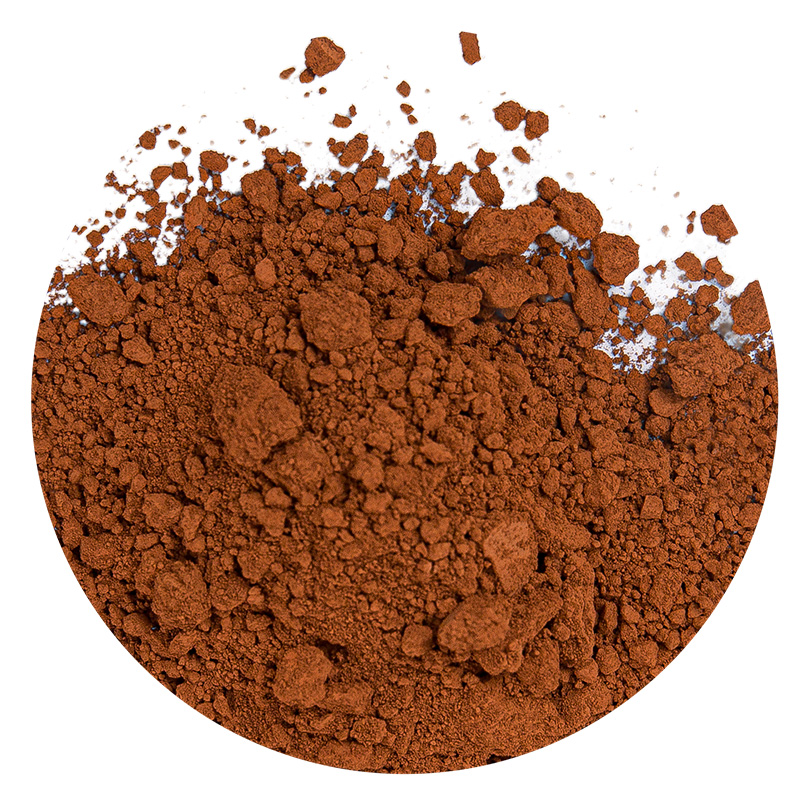 Brown Iron Oxide Powder for Coloring ApplicationsThis brown iron oxide pigment offers strong tinting strength and UV stability. Its consistent particle size helps assess micronized-grade needs before full-scale use, supporting lab-scale sample testing for cost-effective formulation.View Product →
Test Methods You Can Run Before Purchase
The cheapest way to avoid a bad batch is not to run an expensive trial. It is to run three quick, lab-scale checks on a 200 g sample before committing to a full container. Most manufacturers will send a 200 g lab sample of brown iron oxide powder if you ask.
The tests are simple. The Hegman gauge measures the fineness of grind and is the standard way to judge dispersion. The rub-out test compares two areas of the same drawdown, one rubbed and one untouched, to see color drift. A tinting strength comparison uses a pigmented paste against a standard paste at precisely documented ratios.
When you compare grades, for example the 686, 663, and 610 brown pigments, the key difference is usually in particle size and oil absorption, not in the iron oxide content. That is why a small sample batch, tested properly, is worth more than a spec sheet. Refer to our comparison of brown iron oxide 686, 663, and 610 for typical differences.
| Parameter | Typical acceptance range | Test method |
| Tinting strength | 95-105 percent of reference | Spectrophotometer / CIELAB |
| Fineness of grind | 50 microns max | Hegman gauge |
| Moisture | 1.0 percent max | Loss on drying at 105 C |
| Oil absorption | 15-25 g per 100 g | ASTM D281 |
Red Flags and Supply Risks to Check in a New Batch
A shipment that passes a simple sieve check can still fail in production. The differences show up in the details. Batch-to-batch tinting strength drift is the most common complaint in brown iron oxide purchasing, and it usually comes from raw material variation or from an uncontrolled calcination step.
Other red flags include coarse agglomerates that resist high-speed dispersion, unexpected viscosity changes in the paint mill base, heavy metal variability that affects compliance requirements, and color shift from reddish-brown to yellowish-brown when the crystal phase changes. These risks have real cost consequences.
- Uncontrolled calcination temperature produces a harder particle that resists milling.
- Inconsistent raw material feed causes batch-to-batch tinting strength drift.
- High moisture content creates lumping and poor grinding behavior.
- Lack of micronized grade limits your ability to meet fine grind requirements.
These risks are why experienced formulators put real weight on the manufacturer's process control. A supplier who can state that their standard grade, micronized grade, and low heavy metal grade are made under the same control discipline is delivering more than a pigment. It is delivering process stability.
How to Ask the Right Questions to Your Manufacturer
Before you sign a blanket order, ask the manufacturer to submit a technical data sheet that includes tinting strength range, particle size distribution, and dispersion test results on the exact grade you plan to buy. This is not a formality. It is the documentation you need for an incoming inspection procedure.
What this means in practice is that you should never accept a quote that does not include a measured tinting strength value. A manufacturer that can talk about their low heavy metal series, their micronized series, and their standard series with specific numbers is giving you the tools to manage your production risk.
Deqing Demei Pigment Technology Co., Ltd. produces standard, micronized, and low heavy metal series brown iron oxide, and can provide the corresponding tinting strength and dispersion data on request.
- Is this the standard, micronized, or low heavy metal grade? How does it affect dispersion?
- What is the lot-to-lot tinting strength tolerance?
- Can you share the Hegman gauge results for the current production lot?
- What is the typical oil absorption value?
- Do you perform a rub-out test as part of quality control?
Frequently Asked Questions
What is the difference between color strength and tinting strength in brown iron oxide powder?
Color strength is the general term for a pigment's ability to produce color. Tinting strength is the specific measure of how much color a pigment contributes when mixed into a lighter base. For brown iron oxide quality control, tinting strength is the number you use to compare batches.
How much dispersion do I need for a brown iron oxide in an architectural coating?
For a typical water-based architectural coating, a Hegman reading of 25-50 microns is acceptable. For a solvent-borne glossy enamel or a color concentrate, aim for 20 microns or better.
Can I compensate for low tinting strength by adding more pigment?
You can, but it costs more and changes hiding power, viscosity, and potentially the final color. A 10 percent tinting strength deficit usually requires about 10 percent more pigment, which can affect film properties.
What factors affect the dispersion performance of brown iron oxide powder?
Particle size distribution, moisture content, agglomerate hardness, and the manufacturer's milling or micronization step. A micronized grade solves many dispersion issues but is priced accordingly.